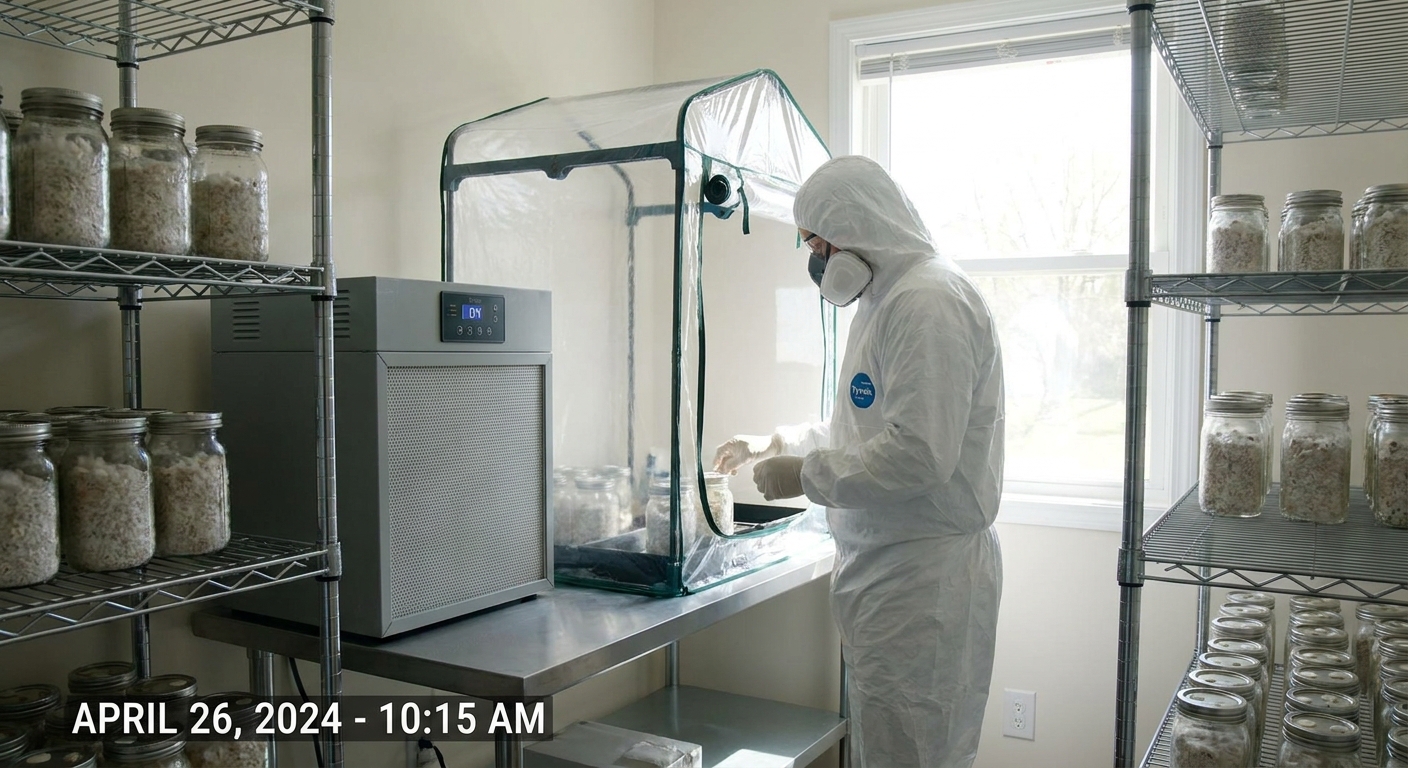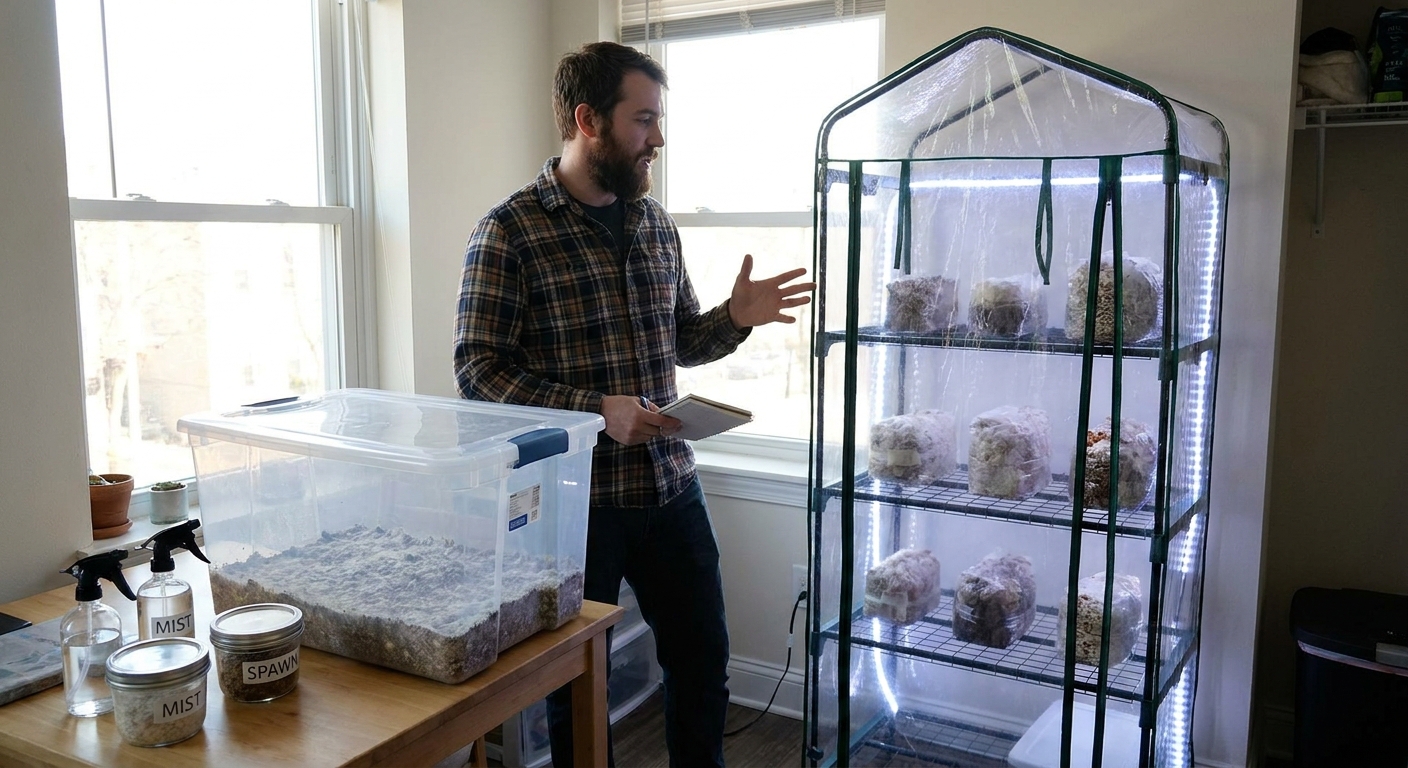
Most home growers eventually face a gear fork in the road: stick with monotubs and shoeboxes, or upgrade to a Martha-style greenhouse tent. Both can produce excellent mushrooms, but they shine in different situations.
Overview
This article compares these systems in a lab-minded way: environmental control, contamination risk, cost, and which species each setup actually favors. You’ll also find concrete build steps and troubleshooting for each.
System 1: Monotubs and Shoeboxes
Monotubs are self-contained plastic totes designed to maintain a microclimate for bulk substrates—especially for tropical, forgiving species.
Best suited for
- Psilocybe cubensis and similar tropical dung/soil decomposers.
- Beginners who want low-maintenance fruiting.
- Growers with limited space or budget.
Core components
- Opaque or translucent tote (45–70 L).
- Drill and hole saw (1–2" / 2.5–5 cm).
- Polyfill or micropore tape.
- Black liner bags (optional but recommended).
- Coco coir, vermiculite, gypsum (CVG) or other bulk substrate.
Environmental targets for cubensis in monotubs
- Consolidation/colonization:
- Temp: 23–26°C (73–79°F).
- Gas exchange: Low to moderate; filtered.
- Light: Not necessary.
- Fruiting:
- Temp: 22–25°C (72–77°F).
- RH: 90–95% at surface.
- FAE: Moderate.
- Light: 12/12 or ambient room light.
Step-by-step monotub build
Drill FAE holes
- 2 rows of holes along the long sides: - 2–3 holes near substrate height. - 2–3 holes near the lid. - Optionally 1 hole per short side for extra FAE.
Deburr and clean
- Sand rough plastic edges. - Wipe tub inside and out with 70% isopropyl.
Install filters
- Stuff holes with loose polyfill, or - Cover with 1–3 layers of micropore tape.
Prepare substrate (CVG example)
- Hydrate coco coir + vermiculite with hot water to field capacity: - When squeezed hard: few drops of water, not a stream. - Pasteurize in a bucket (insulated) with boiling water or in oven bags at 60–70°C (140–158°F) for 1–2 hours.
Spawn to bulk
- In as clean a space as you can manage: - Line tub with trash bag (liner) if using. - Mix 1 part colonized grain spawn to 2–3 parts substrate. - Level surface; avoid compressing too hard.
Colonization phase
- Close lid. - Cover or tape extra holes if your room is very dry. - Keep around 24–25°C; no direct sunlight.
Fruiting phase
- When the surface is fully white and slightly bumpy: - Increase FAE by loosening polyfill or removing extra tape. - Introduce ambient light. - Maintain a slightly glistening surface with fine misting if needed.
System 2: Martha-Style Greenhouse Tent
A "Martha" is a small greenhouse or shelving unit enclosed with plastic, fitted with automated humidity and FAE control.
Best suited for
- Oysters, lion’s mane, shiitake, chestnut mushrooms, and other gourmet species.
- Multiple grow bags or trays at once.
- Growers comfortable with basic wiring/timers and willing to calibrate.
Core components
- 3–5 tier wire shelving rack.
- Greenhouse cover or DIY plastic sheeting with zipper.
- Ultrasonic humidifier.
- Humidity controller (e.g., Inkbird-type).
- Small circulation fan.
- Optional: exhaust fan or passive venting.
General environmental targets
These vary by species; examples:
- Oyster mushrooms (Pleurotus ostreatus / pulmonarius):
- Temp: 15–24°C (59–75°F).
- RH: 90–95% for pinning; 85–92% for fruiting.
- FAE: High; CO₂ should be low.
- Lion’s mane (Hericium erinaceus):
- Temp: 16–22°C (60–72°F).
- RH: 90–95%.
- FAE: Moderate; too strong airflow causes spiny, dry fruit.
Step-by-step Martha build
Assemble rack & cover
- Place rack on a waterproof mat or tray. - Ensure it fits your room height and electrical layout.
Install humidification
- Place ultrasonic humidifier on the bottom shelf or outside with PVC tubing piped in. - Plug humidifier into humidity controller. - Place humidity probe at mid-shelf height, away from direct mist.
Add air movement
- Mount a small fan high inside the tent. - Aim it across, not directly at, the blocks or trays. - For oysters, consider a gentle exhaust fan or cracked zipper for passive venting.
Set controller parameters
- Example for oysters: - Setpoint: 92% RH. - On at 90%, off at 94% (adjust based on condensation/dripping).
Manage condensation & drainage
- Drill small drain holes in low points of the tent plastic (into a tray). - Wipe down excessive condensation on electronics.
Load fruiting blocks
- Place colonized blocks on shelves, spaced for airflow (no touching sides). - Cut X-slits or remove tops of bags per species recommendations.
Sterility and Contamination: Which System Is Safer?
Monotubs
- Pros
- Closed micro-environment; less exposed.
- Easier to isolate a bad tub away from other projects.
- Cons
- Once contaminated, the whole substrate is usually lost.
- Harder to visually monitor early stages of bacteria.
Common monotub contaminants
- Trichoderma (green mold):
- Often appears after first flush or if substrate was too wet.
- Prevent by improving spawn quality and substrate pasteurization.
- Cobweb mold (gray wispiness):
- Thrives in low FAE, high humidity.
- Treated early with 3% H₂O₂ misting and increased airflow, but usually indicates poor conditions.
Martha tents
- Pros
- Better airflow control reduces CO₂-related stress.
- Multiple independent blocks; one contamination doesn’t always doom the rest.
- Cons
- Higher background spore load from mature flushes.
- More condensation & nooks for mold if not cleaned regularly.
Contamination management in a Martha
- Routinely inspect blocks; remove any with strong off-odors or colored molds.
- Deep clean between cycles:
- Empty tent.
- Wipe all surfaces with 10% bleach or 70% iso.
- Run tent dry with fan on to fully air out.
Upstream Sterile Work (Shared for Both Systems)
Both systems fail if spawn and substrate are dirty.
Spawn preparation standards
- Use a pressure cooker capable of 15 PSI.
- Grain (wheat, rye, millet):
- Rinse thoroughly.
- Soak 12–24 hours.
- Simmer until kernels are hydrated but not bursting.
- Steam-dry on screens or towels until surfaces are dry.
- PC quart jars for 90–120 minutes at 15 PSI.
- Always inoculate in a SAB or flow hood.
- Favor agar > grain over spores > grain for consistency.
Bulk substrate hygiene
- For CVG, keep it clean and avoid over-hydration.
- For sawdust-based substrates (gourmet blocks):
- Supplement with bran only if you can sterilize (not just pasteurize) at 15 PSI for 2–2.5 hours.
- Use filter patch bags and seal properly.
Choosing Between Monotub and Martha
Go monotub if:
- You mostly grow cubensis or other tolerant species.
- You have limited time for daily adjustments.
- Your space is dry, small, and you can’t add more electrical gear.
- You’re still dialing in sterile work and want cheap, replaceable containers.
Go Martha if:
- You want to grow oysters, lion’s mane, shiitake, etc.
- You’re comfortable using controllers, fans, and humidifiers.
- You want to run many small blocks rather than a few big tubs.
- You can deep-clean and maintain the tent between cycles.
Hybrid approach
Many small labs run both:
- Monotubs or shoeboxes for cubes and experimental trays.
- Martha tent for gourmet blocks and intensive fruiting.
This spreads risk: if a mold flare-up hits one system, the other can keep producing.
Honest Troubleshooting by Symptom & System
Symptom: Poor pinset in monotub (few mushrooms)
Likely causes
- Surface conditions too dry or too wet.
- Substrate too shallow or spawn ratio too low.
- Ensure substrate depth 7–10 cm (3–4").
- Aim for 1:2–1:3 spawn:substrate.
- Maintain micro-droplets on surface; not puddles.
Adjustments
Symptom: Side pins in monotub
Why it happens
- Liner not used or not tight to substrate.
- Better microclimate at wall–substrate interface.
- Use black trash bag liner; press it flush during spawn mixing.
- Consider flipping the block out after colonization to expose side pins if they’re unavoidable.
Practical fixes
Symptom: Oysters with long stems, tiny caps in Martha
Diagnosis
- High CO₂ (insufficient FAE).
- Increase exhaust: slightly open zipper or add vent holes.
- Run circulation fan more frequently.
- Reduce number of bags if tent is overpacked.
Fixes
Symptom: Lion’s mane turning yellow and fuzzy
Potential causes
- Too dry: low RH or strong direct airflow.
- Too warm: upper end of or outside optimal temp.
- Raise RH setpoint to 93–95%.
- Deflect airflow away from fruits.
- Improve temperature control or choose a cooler location.
Adjustments
Scaling Thoughtfully
Whatever system you choose, grow like a lab, not a factory:
- Scale your sterile capacity first (agar plates, clean spawn) before adding more tub or tent space.
- Log data for each run: species, substrate, spawn ratio, parameters, outcomes.
- Only change one major variable between cycles when troubleshooting.
With a monotub, a Martha, or a mix of both, a consistent, lab-minded approach turns your gear into a reliable cultivation system rather than a pile of plastic and guesswork.
Pick the system that matches your species and your tolerance for tinkering, then refine it methodically. The mushrooms will reflect the quality of your setup—and your process.